


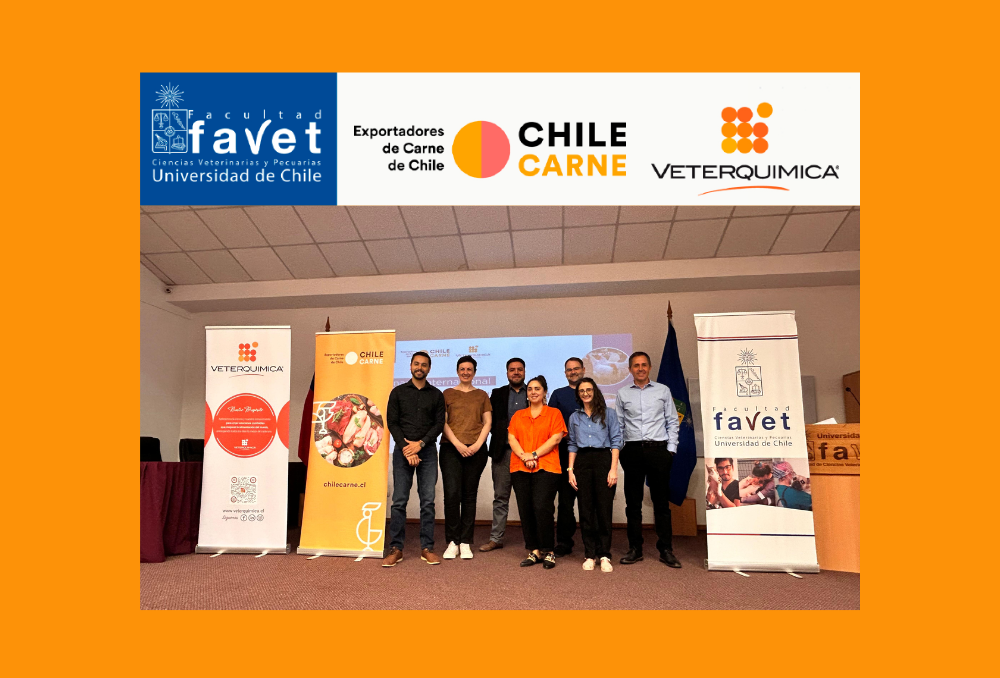
The international seminar “Nutrition and Sustainability in Poultry and Pork Production: Challenges and Opportunities in Chile and Brazil” analyzed the strategic role of nutrition in sustainable poultry and pork production in Chile and Brazil. It was organized by Universidad de Chile’s School of Veterinary and Animal Sciences and sponsored by ChileCarne and Veterquímica, a leading company in animal nutrition and health solutions. The seminar brought together around 60 practitioners and students, along with eight academic and industry speakers from Chile and abroad.
The seminar took place on January 14th at Universidad de Chile’s School of Veterinary and Animal Sciences. It brought together representatives from the production, technical, and academic sectors interested in an integrated view of the challenges facing poultry and pork production.
In a context marked by rising production, health, and environmental requirements, the seminar highlighted how nutrition has evolved from an operational variable into a strategic tool that is closely linked to efficiency, environmental care, and animal health and welfare. The following topics were addressed from a practical and comparative perspective, integrating scientific evidence and the experience of Chile and Brazil.
Nutrition as a strategic pillar for production sustainability
One of the seminar’s overarching messages was that sustainable production systems must integrate nutrition into decision-making. The experiences of Chile and Brazil show that both countries face common challenges, including input variability, increasing resource-use efficiency, and strengthening production resilience amid increasingly complex health and environmental scenarios.
Nutritional innovation appears to be one of the key tools for responding to these challenges. The speakers emphasized the importance of moving toward feeding strategies that better align with the animals’ actual needs to optimize input use and contribute to more stable, predictable production, especially in environments with high production variability.
In his talk, Dr. Sergio Guzmán, professor at Universidad de Chile, highlighted that Chile is well-positioned in poultry and pig production, making it a leader in Latin America. Still, its main challenge in sustaining this leadership is environmental sustainability. Guzmán explained that nutrition plays a key role, primarily through precision nutrition strategies that deliver the exact nutrients animals require, thereby improving production efficiency and reducing environmental impacts by integrating more technology into the country’s production systems.
Dr. Luciano Hauschild, professor at Universidade Estadual Paulista in Brazil, praised the high level of mechanization in Chile’s pork production, driven by its strong focus on exports and the requirements it entails. He also highlighted the contribution of local research, emphasizing its robust scientific methodologies and focus on real problems in commercial production. Hauschild concluded that there are similarities between production systems in Chile and southern Brazil, and that there is a shared focus on strengthening cooperation among universities, trade associations, and producers, an objective that initiatives such as this seminar seek to promote.
Innovation, new ingredients, and production resilience
The conference also addressed the use of new ingredients and by-products in animal feed as an opportunity to move toward more circular and sustainable production models. Input diversification is an option with great potential, provided it is accompanied by adequate knowledge of its nutritional characteristics and by management practices that ensure consistent production and animal yield.
Experts also stressed that production sustainability depends not only on nutrition but also on its interaction with other key factors, such as management, genetics, and the production environment. Adapting feeding strategies to increasingly demanding systems was also highlighted, with consideration for different production stages and reducing variability across farms.
Animal welfare was also addressed as an inseparable component of sustainability, emphasizing that the human-animal relationship and environmental conditions directly influence animal behavior and yield. This approach reinforces the need to move toward comprehensive models that treat the animal and its environment as part of the production system.
For ChileCarne, the seminar reaffirmed the importance of such opportunities for training, technical updates, and the sharing of international experiences to strengthen the sector’s capabilities and align meat production with current and future challenges, where nutrition becomes a key driver of more sustainable, resilient, and evidence-based production.
Speakers and presentations
Dr. Sergio Guzmán – Universidad de Chile
Overview of poultry and pork production in Chile, contextualizing the main productive, health, and environmental challenges facing the industry.
Dr. Inés Andretta – Universidade Federal do Rio Grande do Sul (Brazil)
Overview of poultry and pork production in Brazil and the challenges of incorporating new ingredients into animal nutrition, with an emphasis on nutritional variability.
Dr. Marcos Kipper – Brazil
Production and market context of the Brazilian poultry and pork industries, highlighting structural factors such as land use, health, and trade dynamics.
Dr. Luan Sousa dos Santos – Universidade Federal de Mato Grosso do Sul (Brazil)
Precision nutrition and requirements modeling as tools to improve production efficiency and address system variability.
Dr. Carolina Valenzuela – Universidad de Chile
Parenteral nutrition in pigs and the potential of alternative insect-based ingredients, from a sustainability and circular economy perspective.
Dr. Gabriela Miotto – Universidade Federal do Rio Grande do Sul (Brazil)
Nutritional challenges of hyperprolific sows, highlighting the need to adjust feeding strategies to the animals’ physiological state.
Dr. Daniela Luna – Universidad de Chile
Impact of human-animal relationship and social enrichment on animal welfare, behavior, and yield.
Dr. Luciano Hauschild – Universidade Estadual Paulista (Brazil)
Nutritional and feeding strategies for pigs to address health challenges, highlighting the use of functional amino acids to strengthen immune response and improve yield.


